


16 Sep Customized Insurance for Business Owners: A 2026 Guide
Table of Contents
- What Is Customized Insurance for Business Owners?
- Why One-Size-Fits-All Coverage Falls Short
- Business Insurance Coverage Examples That Matter
- Building Your Business Insurance Risk Assessment Checklist
- Customized Insurance for Remote and Hybrid Business Models
- How to Get a Business Insurance Quote and Policy Endorsements
- Managing Your Insurance Lifecycle and Annual Renewal
- Conclusion
Last Updated: August 15, 2026
What Is Customized Insurance for Business Owners?
Customized insurance for business owners is a tailored approach to commercial coverage that matches your specific risks, assets, and industry requirements rather than forcing you into a one-size-fits-all policy. At Colstan & Associates, we’ve worked with business owners who discovered that generic policies left critical gaps in their protection. Instead of accepting standard coverage limits and deductibles, customized insurance starts with an honest audit of what you actually own, what could harm your business, and what regulatory requirements apply to your operation.
A retail shop faces different risks than an auto repair facility. A remote consulting business operates under different liability exposure than a restaurant with 50 employees. Customized insurance acknowledges these differences and builds coverage around them, resulting in protection that fits, premiums reflecting your actual risk profile, and fewer surprises when you file a claim.
Why One-Size-Fits-All Coverage Falls Short
Most business owners accept whatever policy structure their carrier offers and renew it annually without question. This works until something goes wrong, and then the gaps become obvious.
Generic commercial policies are designed for statistical averages, not your specific situation. A standard general liability policy might include insufficient coverage limits for your industry’s actual claims history. Professional liability coverage that works for one service business may exclude the exact services you provide. Workers compensation structures assume a typical workforce when your operation might be entirely remote or heavily reliant on independent contractors.
The real cost of generic coverage isn’t always visible. You might pay for protection you don’t need while missing coverage you desperately do. You might discover mid-claim that a particular incident falls into an exclusion you never noticed. You might face regulatory penalties because your policy doesn’t meet your industry’s specific compliance requirements. Colstan & Associates has seen business owners caught in each of these situations, and most thought their insurance was adequate until they needed it.
Customized insurance for business owners shifts the burden where it belongs: on the insurer and agent to understand your operation, not on you to guess what you might need.
Business Insurance Coverage Examples That Matter
Understanding the different types of commercial coverage available is the first step toward building a customized policy. Each coverage type serves a specific purpose, and the right combination depends entirely on your business model, industry, and asset base.
General Liability and Commercial Property
General liability insurance protects your business when a customer, client, or third party claims bodily injury or property damage caused by your operations. If a client trips in your office and breaks their arm, or your business causes damage to someone else’s property, general liability covers the legal defense and settlement costs.
Commercial property insurance protects the physical assets your business depends on: your building, equipment, inventory, and fixtures. If a fire destroys your workshop or a storm damages your roof, commercial property insurance covers the replacement cost. Many business owners underestimate the value of their assets until they actually list everything.
The coverage limits you choose should reflect your actual exposure. A consulting business working from a home office faces vastly different property risks than a manufacturing facility. A service business with minimal inventory faces different liability exposure than a retail operation where customers move through your space daily.
Workers Compensation and Professional Liability
Workers compensation insurance is mandatory in most states if you have employees. It covers medical expenses and lost wages for employees injured on the job and protects you from lawsuits by injured workers.
Professional liability insurance (also called errors and omissions coverage) protects service-based businesses when a client claims your work caused them financial harm. An accountant who misses a tax deduction, a consultant whose recommendation backfires, or a contractor whose installation fails, professional liability covers the legal and settlement costs. This coverage is essential for any business that provides advice, design, planning, or specialized services.
Many business owners skip professional liability because they don’t think their work could cause significant harm. Then a client sues, and the cost of legal defense alone exceeds what they would have paid in premiums for years.
Industry-Specific Coverage for Auto Repair and Retail
Auto repair shops face specialized risks that generic commercial policies don’t address adequately. You’re working with customer vehicles worth thousands of dollars, using specialized equipment and hazardous materials, and managing liability for work performed on someone else’s property. Customized insurance for auto repair shops includes coverage for customer vehicles in your care, tools and equipment, and work liability.
Retail businesses face different specialized risks: inventory shrinkage from theft, liability from customer slip-and-falls, product liability if you sell items that cause harm, and business interruption if you can’t operate due to a covered event. A retail policy needs to account for your specific inventory value, foot traffic volume, and the types of products you sell.
These industry-specific considerations are why off-the-shelf policies fail. Colstan & Associates works with business owners in specialized industries to ensure their policies address the actual risks they face.
Building Your Business Insurance Risk Assessment Checklist
The foundation of customized insurance for business owners is a thorough risk assessment. This is a practical audit of your operation that identifies what needs protection and what coverage limits make sense.

Audit Your Business Assets and Operations
Start by listing everything your business owns or depends on: physical assets (building, equipment, inventory, vehicles, furniture), financial assets (accounts receivable, cash reserves), and operational assets (customer lists, intellectual property, data systems). Walk through your space and document what’s there.
Next, document how your business operates. How many employees do you have? Do they work on-site, remotely, or a mix? What services or products do you provide? What’s your annual revenue? This operational snapshot reveals where your business is vulnerable.
The goal is to see your business clearly enough to identify what would hurt if something went wrong. If your business depends on a specific piece of equipment, that equipment needs coverage. If your business depends on your building, that building needs adequate property insurance.
Identify Industry-Specific Risks
Every industry has risks that others don’t. Manufacturing faces machinery breakdown and product liability. Service businesses face professional liability and client disputes. Hospitality faces liquor liability and food safety. Retail faces inventory theft and customer injury.
Research your industry’s common claims. Talk to competitors or industry associations. Ask yourself: what incidents have happened to other businesses in my field? What claims are most common? What incidents would be catastrophic for my business?
Colstan & Associates works with business owners across industries to identify these specific risks and ensure customized insurance includes the coverage that actually matters in your field.
Determine Your Coverage Limits and Deductibles
Coverage limits are the maximum amount your insurance will pay for a claim. Deductibles are the amount you pay out of pocket before insurance kicks in. These two decisions directly affect your premiums and your financial protection.
Higher limits cost more in premiums but protect you more completely. Higher deductibles cost less in premiums but mean you pay more out of pocket if something happens. The right balance depends on your financial position and your risk tolerance.
A common mistake is choosing limits based on what sounds adequate rather than what actually reflects your exposure. If you manage $500,000 in customer assets, your professional liability limit should be at least that much. If your building is worth $2 million, your property coverage should reflect that value. Your deductible should be an amount you could actually pay if a claim occurred.
Customized Insurance for Remote and Hybrid Business Models
Remote and hybrid work has fundamentally changed business insurance needs, yet many policies still reflect traditional office-based operations. A business with employees working from home faces different risks than one with everyone in a central location.
Cyber liability becomes critical. Remote workers access company data from home networks, use personal devices, and communicate through digital channels. A data breach or ransomware attack could disrupt your entire operation. Cyber insurance covers the costs of breach response, notification, recovery, and business interruption.
General liability coverage needs adjustment. If clients never visit your physical office, your premises liability exposure is lower. If employees work from home, your workers compensation exposure is different. Professional liability takes on new dimensions with digital delivery of services and reliance on technology. Business interruption coverage becomes more important, if your internet goes down or your cloud services fail, can you afford the lost revenue?
How to Get a Business Insurance Quote and Policy Endorsements
Getting a customized insurance quote requires more than filling out an online form. The process should involve a conversation with an agent who understands your business, asks detailed questions, and helps you think through your actual needs.
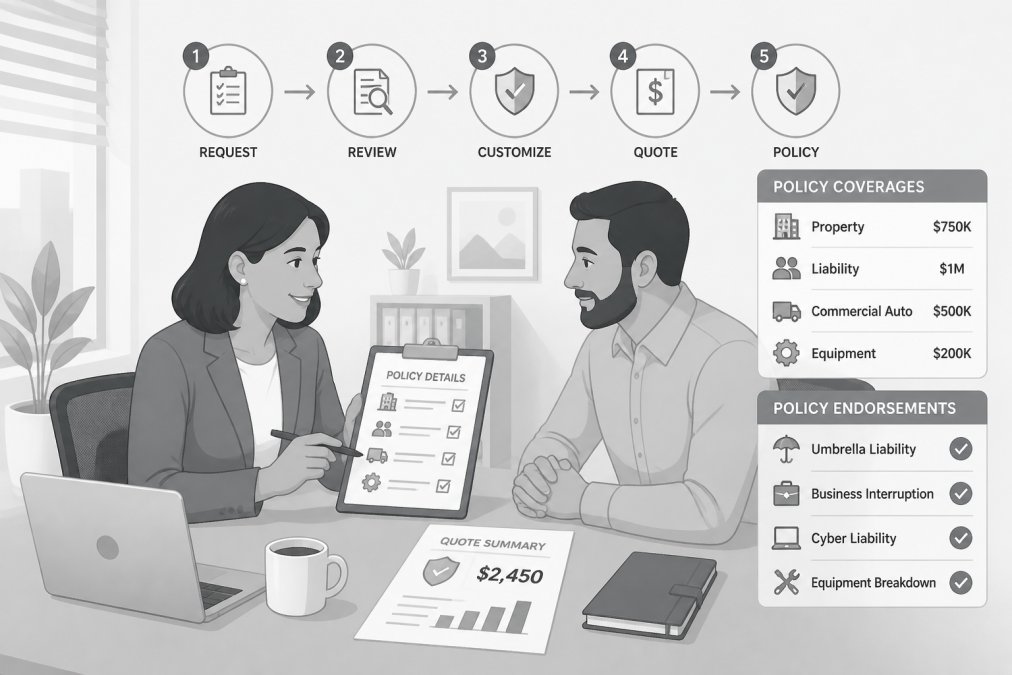
Start by gathering information about your business: annual revenue, number of employees, type of work, years in operation, prior claims history, and any safety programs you’ve implemented. The more detail you provide, the more accurate your quote will be.
When you contact an agent, be specific about your operation. Describe exactly what services you provide, to whom, and how. Say how many employees you have, what they do, and how they work. This specificity allows the agent to recommend appropriate coverage rather than guessing.
Ask about policy endorsements. An endorsement is an addition or modification to your standard policy that customizes it for your specific needs. You might add coverage for specific equipment, extend coverage to specific clients or projects, or modify limits for particular exposures. Compare quotes from multiple sources, but don’t choose based on price alone. Compare what’s actually covered, what limits are included, what deductibles apply, and what endorsements are available.
Managing Your Insurance Lifecycle and Annual Renewal
Customized insurance for business owners isn’t a one-time setup. Your business changes, your assets change, and your risks change. Your policy should change with them.
Annual renewal is the obvious checkpoint, but it shouldn’t be the only one. If you make major changes, add employees, expand services, purchase equipment, or move to a new location, contact your agent and review your coverage. A significant change might require a policy adjustment or an endorsement.
Keep documentation of your assets, operations, and any incidents that occur. When renewal time comes, your agent can use this information to ensure your policy still fits. If you’ve added equipment worth $100,000, your property limits might need to increase. If you’ve expanded into a new service area, your professional liability coverage might need adjustment.
After a claim is resolved, review what happened and whether your coverage was adequate. This real-world experience often reveals gaps that didn’t show up in the initial assessment. Colstan & Associates treats insurance as an ongoing partnership, not an annual transaction, reaching out proactively to review your coverage and make adjustments before a gap becomes a problem.
The difference between adequate insurance and customized insurance for business owners is the difference between hoping you’re covered and knowing you are. A customized approach takes time upfront to audit your assets, understand your risks, and think through your actual exposure. That investment pays off when you need it, when a claim comes in and you discover your coverage actually addresses what happened. It also pays off in premiums: coverage that fits your actual risk costs less than coverage that overshoots or undershoots your needs.
Start with an honest conversation with an agent who understands your business. Describe your operation in detail. Walk through your assets. Think about what could actually harm your business. Then build a policy that protects against those specific risks with limits that actually reflect your exposure. That’s customized insurance for business owners, and it’s the only approach that makes sense.
Frequently Asked Questions
What are the core components of a customized business insurance policy?
A customized business insurance policy typically includes general liability to cover bodily injury and property damage claims, commercial property insurance to protect your physical assets, workers compensation if you have employees, and professional liability or errors and omissions coverage depending on your industry. Many businesses also add cyber liability, business interruption, and commercial auto coverage. The specific components depend on your business type, size, and risk profile. A licensed insurance agent can help you determine which coverages your business actually needs rather than paying for unnecessary protection.
How do insurance providers determine risk for small business owners?
Insurance providers assess risk through underwriting, which examines your business operations, industry type, claims history, number of employees, annual revenue, and the specific services or products you offer. They evaluate your business assets, safety practices, and regulatory compliance. For specialized businesses like auto repair shops or restaurants, insurers consider industry-specific risks such as equipment exposure or food safety protocols. This risk assessment directly influences your coverage limits, deductible options, and premium. A thorough risk assessment ensures you're not overpaying for coverage you don't need while maintaining adequate protection for your actual exposures.
How often should a business owner review and adjust their insurance coverage?
You should review your customized insurance policy annually during renewal and whenever significant business changes occur. Major events triggering a review include hiring additional employees, expanding into new locations, adding equipment or inventory, changing your business structure, or entering new markets. Many business owners also benefit from proactive reviews every 18-24 months to ensure coverage limits keep pace with business growth and inflation. Regular policy reviews help identify coverage gaps, eliminate unnecessary endorsements, and ensure your protection remains aligned with your current business assets and risks.
What is the difference between general liability and professional liability insurance?
General liability insurance covers bodily injury, property damage, and advertising injuries caused by your business operations, products, or premises. It protects against third-party claims like a customer slipping on your floor. Professional liability insurance, also called errors and omissions coverage, protects against claims of negligence, mistakes, or failure to perform professional services. A consultant, accountant, or attorney would need professional liability; a retail store or restaurant would prioritize general liability. Many businesses benefit from both coverages depending on the services they provide. Understanding which applies to your business prevents costly coverage gaps.
This article was written using GrandRanker