


03 Aug Get Commercial Insurance Quote Online: A 2026 Guide
Table of Contents
- How to Get a Commercial Insurance Quote Online
- What Information You’ll Need for Your Quote
- Getting a Small Business Insurance Quote Online
- Commercial General Liability Insurance Quote Online
- Compare Business Insurance Quotes Effectively
- Understanding Commercial Insurance Cost Factors
- Common Mistakes to Avoid When Getting a Quote
- Why Choose Colstan & Associates for Your Commercial Insurance Quote
Get Commercial Insurance Quote Online: A 2026 Guide
Last Updated: July 27, 2026
Getting a commercial insurance quote online has become essential for business owners who need fast, transparent pricing without spending hours on the phone. At Colstan & Associates, we’ve helped hundreds of business owners navigate this process and move from quote to coverage in days instead of weeks. When you understand what information you’ll need and how to compare your options effectively, you can secure the right protection quickly.
How to Get a Commercial Insurance Quote Online
Start by identifying which types of coverage your business needs. A manufacturing facility has different exposure than a consulting firm, and a construction contractor faces risks that a retail store doesn’t. Most online quote platforms walk you through a guided form in 10-20 minutes, asking about your business structure, annual revenue, number of employees, and specific operations.
The real advantage is transparency. You see exactly what you’re being quoted and why. You can adjust deductibles and coverage limits to watch prices change in real time. After receiving quotes, compare at least three options from different carriers. Look beyond the premium to understand what’s included, a lower price means nothing if coverage limits are inadequate or deductibles are unreasonably high.
Many business owners skip reviewing their current coverage before getting a new quote. If you’ve been insured for a few years, your business has likely changed. Bring your old policy to the quote process and use it as a starting point for what you actually need.
Step 1: Gather Your Business Information
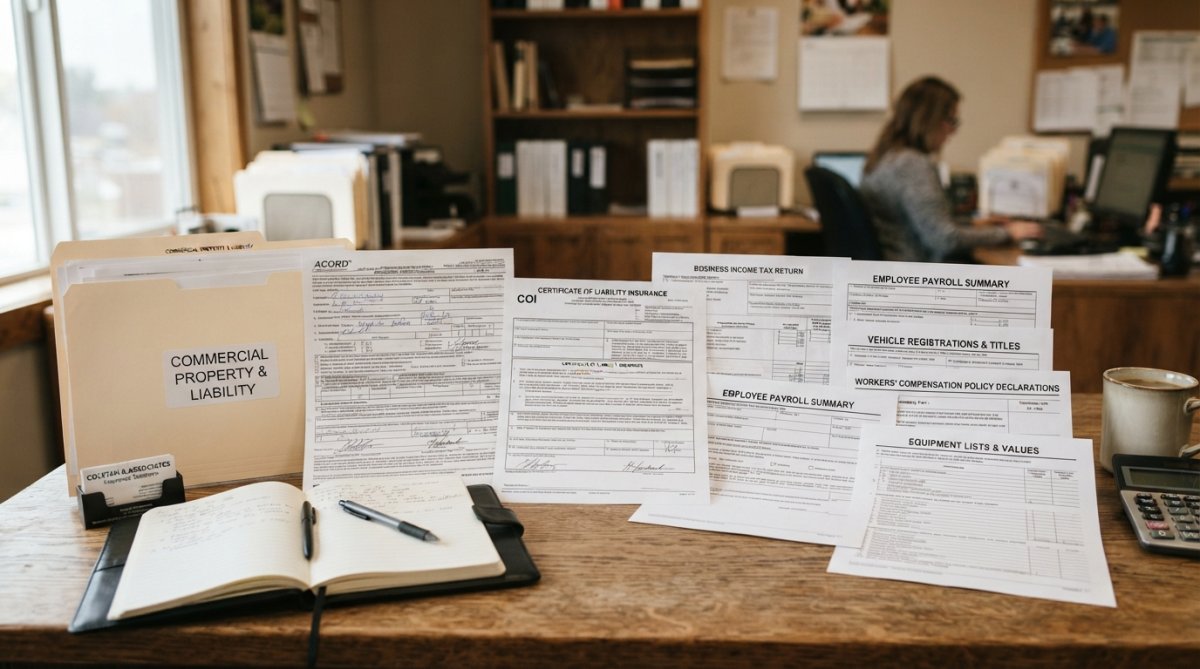
Before starting your quote, collect the documents and information you’ll need. Start with your business formation documents: legal entity type (sole proprietorship, LLC, partnership, or corporation), business tax ID number (EIN), and establishment date. Have your last year’s federal tax return or business financial statements ready, as carriers need your annual revenue because it affects your exposure and risk profile. If you’re new, provide projected revenue based on your business plan.
Prepare a detailed description of your business operations. Don’t just say "construction company." Explain what types of projects you undertake, whether you work on residential or commercial sites, and what equipment you operate. The more specific, the more accurate your quote will be.
Step 2: Choose Your Coverage Types
Understanding what each coverage type does helps you make decisions aligned with your real business needs.
Commercial general liability is the foundation for most businesses. It covers bodily injury, property damage, and personal injury claims from your business operations. Most businesses need at least $1 million in general liability coverage, though contractors and service providers often need $2 million or more.
Commercial auto insurance is required by law if you own vehicles for business purposes. Workers’ compensation is mandatory in most states if you have employees. Professional liability insurance (errors and omissions) protects service-based businesses if a client claims your work caused them financial loss. Property insurance covers your business building, equipment, inventory, and other physical assets against fire, theft, weather damage, and other perils.
The coverage types you need depend entirely on your business structure, industry, and operations. Don’t assume you need everything, but don’t skip coverage just to save money on premiums.
Step 3: Complete the Online Quote Form
Answer questions accurately and completely. Vague answers lead to inaccurate quotes. Be honest about claims history, carriers will find this information anyway during underwriting, and misrepresenting it gives them grounds to deny claims later.
When you reach the coverage limits section, resist choosing the minimum. Think about your actual exposure. If you operate heavy equipment, your liability exposure is higher. Set coverage limits that actually protect your business. Most platforms let you see preliminary quotes before submitting your full application. Review these carefully and correct any errors before proceeding.
Step 4: Review and Compare Your Options
After submitting your application, you’ll typically receive quotes from multiple carriers within 24-48 hours. Create a comparison spreadsheet listing each carrier, annual premium, coverage limits, deductible amounts, and special features or discounts.
Don’t automatically choose the lowest price. A quote $200 cheaper annually might come with a $2,500 deductible instead of $1,000. Calculate the true cost by considering what you’d pay out of pocket if you had a claim. Look for carrier-specific discounts for bundling policies, implementing safety programs, maintaining good credit, or having no claims history.
Never skip reading what’s actually covered in each quote. Some carriers use broad language in summaries but exclude specific situations in detailed policy language. If you’re unsure whether something is covered, contact the carrier before binding coverage.
What Information You’ll Need for Your Quote
Business Details and Entity Type
Your business entity type affects your insurance options and pricing. You’ll need your business formation date, Employer Identification Number (EIN), and business license number. Carriers also want to know your business location and whether you rent or own. If you have multiple locations or operate in multiple states, provide information about each.
Financial and Operational Information
Your annual revenue directly affects your quote. If you’re new, provide projected revenue based on your business plan. Provide detailed information about your employees, including total payroll and breakdown by job classification. Describe your business operations in detail, specify what types of projects you undertake and what percentage falls into each category.
Documentation Checklist
- Business formation documents
- Most recent federal tax return or financial statements
- Payroll information
- Current or previous insurance policies
- Business location and lease agreements
- Description of operations and equipment
- Previous claims or losses (past 3-5 years)
- Business vehicles information
- Subcontractor or temporary worker details
- Specialized equipment or high-value asset information
Getting a Small Business Insurance Quote Online
Small businesses benefit from online quotes because you can compare options without needing an agent’s time. You control the process and timeline. Start with the basics: general liability, property insurance if you own equipment or inventory, and workers’ compensation if you have employees.
Don’t assume you need a $2 million general liability limit. A small service business might be adequately protected with $1 million. Right-sizing your coverage to your actual business means you pay appropriate premiums while staying protected.
Small business owners often hesitate to get quotes because they worry about cost. But the cost of not being insured, even for a single claim, is almost always higher than the annual premium. Get the quotes, you might be surprised at how affordable adequate coverage actually is.
Commercial General Liability Insurance Quote Online
Why General Liability Matters for Most Businesses
General liability covers bodily injury, property damage, and personal injury claims from your operations. The cost of defending against a liability claim, even one without merit, can be substantial. Legal fees alone can reach thousands of dollars. If you’re found liable, you could owe damages far exceeding your annual revenue.
Most clients and contracts require proof of general liability insurance. Many won’t work with you without it.
Coverage Limits and Deductibles Explained
General liability quotes typically show three coverage limits: per-occurrence limit, aggregate limit, and products/completed operations aggregate. The per-occurrence limit is what the policy pays for any single incident. The aggregate limit is the maximum the policy pays for all claims in a year. These are typically shown as "1M/2M" meaning $1 million per occurrence and $2 million annual aggregate.
Choosing the right limit depends on your exposure. A small consulting firm might be adequately protected with $1M/$2M limits. A contractor working on high-value commercial projects might need $2M/$4M or higher. The deductible is what you pay out of pocket before insurance kicks in. A higher deductible typically reduces your premium significantly.
Compare Business Insurance Quotes Effectively
| Comparison Factor | Why It Matters | What to Check |
|---|---|---|
| Annual Premium | Your direct cost | Total annual cost, not monthly |
| Per-Occurrence Limit | Protection per incident | Adequate for your industry exposure |
| Aggregate Limit | Total annual protection | Sufficient for your business size |
| Deductible Amount | Your out-of-pocket cost | Balance between premium and risk |
| Coverage Inclusions | What’s actually covered | Read the detailed policy, not just the summary |
| Exclusions | What’s NOT covered | Identify any gaps in your protection |
| Available Discounts | Potential savings | Bundle discounts, safety program credits, claims-free discounts |
| Carrier Financial Strength | Ability to pay claims | Check ratings from A.M. Best or Standard & Poor’s |
Self-Service vs. Agent-Assisted Quotes
Self-service quotes are faster and let you control the timeline. Agent-assisted quotes take longer but provide personalized guidance. An agent can ask clarifying questions about your operations and suggest coverage you might not have considered. Many business owners benefit from a hybrid approach: use the self-service platform to get initial quotes, then request an agent callback to discuss your specific situation.
Quote-to-Bind Timeframes: What to Expect
A straightforward quote from a major carrier might bind the same day you apply or within 24 hours. More complex situations may require underwriting review that takes 3-5 business days. Most quotes remain valid for 30-60 days. If your business situation changes significantly, get updated quotes.
Understanding Commercial Insurance Cost Factors
Your business classification is the primary cost driver. Carriers assign each business to a classification code reflecting the inherent risk of that type of work. A software developer has lower risk than a roofer, so their general liability premium is lower.
Your claims history affects your premium significantly. A business with no claims history gets better rates than one with multiple claims. Your business size, measured by revenue and number of employees, affects your premium. Your location affects your premium as well, insurance regulations, claim frequencies, and litigation costs vary by state and county.
Industry-Specific and State-Specific Requirements
Different industries face different insurance requirements. Construction contractors must carry workers’ compensation and often need higher general liability limits. Healthcare providers need professional liability insurance. State requirements also vary significantly. Some states require workers’ compensation if you have even one employee. Professional licensing requirements may mandate insurance to maintain your license.
Common Mistakes to Avoid When Getting a Quote
The biggest mistake is providing inaccurate information. If you understate your revenue, number of employees, or operational complexity, your quote will be inaccurate. When you bind coverage and the carrier discovers the true information during underwriting, they may cancel your policy or charge significantly more.
Many business owners skip coverage types they think they don’t need, only to discover later they do. When you get a commercial insurance quote online, at least get quotes for all coverage types that might apply to your business. Ignoring available discounts leaves money on the table. Many carriers offer 10-25% discounts for bundling policies, maintaining good credit, implementing safety programs, or having no claims history.
Binding coverage without reading what’s actually covered is dangerous. Spend 15 minutes reading the actual coverage before you bind. If you don’t understand something, ask the carrier to explain it.
Never bind coverage without confirming your deductible amount and coverage limits. These are the most important parts of your policy. A policy with $500,000 coverage limits won’t protect you adequately if you have $2 million in exposure. Confirm these details match your needs before coverage becomes effective.
Why Choose Colstan & Associates for Your Commercial Insurance Quote
When you’re ready to get a commercial insurance quote online, Colstan & Associates brings twenty years of dedicated service and a client-first approach. We’re a family-owned and operated insurance agency licensed in 23+ states, which means we understand regional differences in insurance requirements and can help you navigate state-specific mandates.
We ask detailed questions about your operations, industry, and specific risks to recommend coverage that actually protects your business. We manage renewals proactively rather than letting you discover changes at renewal time. When you file a claim, we handle the process on your behalf. You’re not navigating the claim process alone.
Getting a commercial insurance quote online doesn’t have to be overwhelming. When you understand what information you need, what coverage types matter for your business, and how to compare quotes effectively, the process becomes straightforward. Colstan & Associates has guided hundreds of business owners through this process, helping them find comprehensive coverage at prices that fit their budgets. Start your quote today and discover how personalized insurance service protects what you’ve worked hard to build.
Frequently Asked Questions
What information do I need to get a commercial insurance quote online?
You'll typically need your business name, type, location, number of employees, annual revenue, details about business vehicles or equipment, and your zip code. For general liability quotes, describe your operations and any prior claims history. Having your business tax ID and current insurance policies on hand speeds up the process. The more detailed your information, the more accurate your quote will be.
How long does it take to get a commercial insurance quote online?
Most online quote forms take 5-15 minutes to complete, depending on your business complexity. You'll receive an instant quote immediately after submission. However, binding coverage may require additional underwriting, which typically takes 24-48 hours. Some carriers offer same-day binding through their online portal, while others require agent review before finalizing your policy.
Can I compare business insurance quotes online before buying?
Yes. Obtaining multiple quotes from different carriers allows you to compare coverage limits, deductibles, premium costs, and policy features side by side. When comparing, ensure you're looking at the same coverage types and limits across quotes. Pay attention to quote-to-bind timeframes, as some carriers can bind coverage immediately while others need additional processing time.
What's the difference between commercial auto insurance and general liability?
Commercial auto insurance covers vehicles your business owns or uses for work, protecting against bodily injury and property damage claims. General liability covers accidents or injuries that happen on your business premises or due to your operations. Most businesses need both if they operate vehicles and have a physical location. Your industry and business type determine which coverages are essential.
Is getting a commercial insurance quote online cheaper than working with an agent?
Online quotes often show competitive rates because you're comparing multiple carriers directly. However, agents may find discounts or customized coverage you'd miss on your own. The real savings come from accurate underwriting and proper coverage limits, inadequate coverage can cost far more than premium savings. Consider your comfort level: self-service is faster, but agent-assisted quotes provide personalized risk assessment and ongoing support.
This article was written using GrandRanker