


28 Sep File a Business Insurance Claim Correctly
Table of Contents
- What to Do After a Business Property Loss
- Create a Business Insurance Claim Documentation Checklist
- Review Your Policy Coverage and File Your Claim
- How to Talk to an Insurance Adjuster
- Prevent Further Damage and Track Your Claim
- Common Mistakes That Delay or Deny Claims
- Frequently Asked Questions
Last Updated: September 27, 2026
What to Do After a Business Property Loss
The first hours after a business property loss are critical. Your immediate actions will shape how smoothly your business insurance claim moves forward. Don’t panic. Focus on safety first, then document everything.
Start by ensuring no one is in danger. If the loss involves fire, flooding, or structural damage, evacuate immediately and call emergency services. Once everyone is safe, take basic photos or videos of the damage with your phone. These images are your first line of evidence.
Next, contact your insurance provider as soon as possible. Most policies require timely notification of losses. A quick call protects your claim from potential delays. You don’t need a detailed report yet, just let them know what happened and when.
Keep your insurance agent’s phone number saved in your phone. When disaster strikes, you won’t have time to search for contact info. A fast call can prevent claim denials based on late notification.
Create a Business Insurance Claim Documentation Checklist
Documentation is everything in a business insurance claim. The more evidence you gather, the stronger your claim becomes. Start organizing your proof of loss immediately.
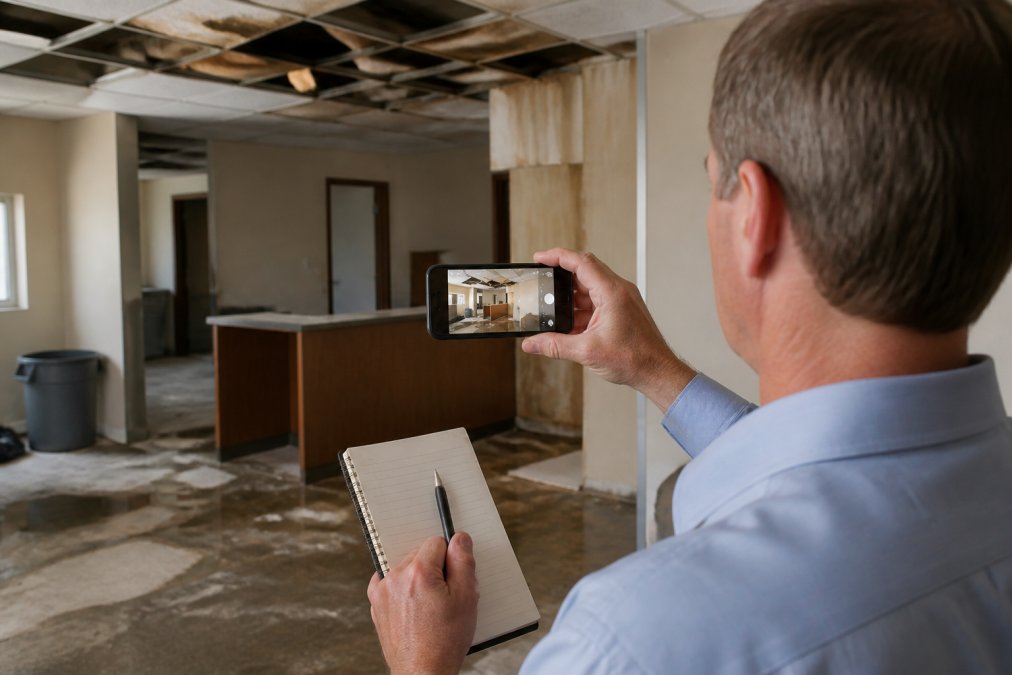
Immediate Documentation Steps
Gather these items within 24-48 hours of the loss:
- Take photos and videos from multiple angles
- Photograph close-ups of damage and serial numbers
- Record the date and time of each photo
- Write down what was damaged and estimated value
- Note the cause of loss (fire, water, theft, etc.)
- Keep receipts, invoices, and purchase records
- List any business interruption (lost revenue, extra expenses)
- Document temporary repairs you make to prevent further damage
Your documentation becomes the foundation of your claim. Adjusters rely on it to determine what happened and what needs to be paid.
Organizing Your Proof of Loss
A proof of loss is a formal statement describing what was damaged and its value. This document is legally required in most policies. Organize your information into these categories:
- Property damaged: List each item with description and value
- Date of loss: When the incident occurred
- Cause of loss: What caused the damage
- Estimated repair or replacement cost: Your best estimate
- Supporting documentation: Photos, receipts, invoices
Create a simple spreadsheet or document. Include columns for item description, purchase date, original cost, current condition, and replacement cost. This organized approach makes it easier for the claims adjuster to review and approve your claim.
The clearer your documentation, the faster your claim settles. Disorganized claims often get delayed while adjusters request additional information.
Review Your Policy Coverage and File Your Claim
Before filing, understand what your policy actually covers. Many business owners discover gaps in coverage only after a loss occurs. Your policy document outlines coverage limits, deductibles, and exclusions.
Look for these key elements:
- Coverage limits: Maximum amount the policy will pay
- Deductible: Amount you pay before insurance kicks in
- Exclusions: What the policy does NOT cover
- Policy provisions: Specific conditions and requirements
- Business interruption coverage: Compensation for lost income during shutdown
- Appraisal or dispute resolution clause: The process for resolving disagreements over claim value
Once you understand your coverage, contact your insurance provider to file your claim. Provide your policy number, date of loss, and a brief description of what happened. Your insurance agent can guide you through the process.
Submit your claim in writing when possible. Email or mail your proof of loss along with supporting documentation. Keep copies of everything you submit. Request written confirmation that your claim was received.
What to Do If Your Claim Is Denied or Underpaid
Not every claim settles smoothly. If your insurer denies your claim or offers significantly less than you believe is owed, you have options.
Understand the denial reason. Request a detailed written explanation of why the claim was denied. Common reasons include:
- The loss falls under a policy exclusion
- You missed the deadline for filing proof of loss
- The damage predates the policy or occurred during a lapsed coverage period
- The insurer disputes the cause of loss
- Documentation was incomplete or contradicted the claim
Review the denial letter carefully against your policy language. If the insurer’s interpretation seems wrong, gather evidence that supports your position.
Request an appraisal. Most commercial policies include an appraisal clause. If you and the insurer disagree on the value of the loss, either party can demand an appraisal. Here’s how it works:
- You and the insurer each select an independent appraiser
- The two appraisers select a neutral umpire
- The appraisers inspect the damage and submit valuations
- If they disagree, the umpire reviews both and makes a binding decision
- The cost is typically split between you and the insurer
Appraisal is faster and less expensive than litigation, and the decision is binding on both parties.
File a complaint with your state insurance regulator. If you believe the insurer acted in bad faith, for example, by ignoring evidence or applying policy language incorrectly, you can file a complaint with your state’s Department of Insurance.
Do not ignore a denial or underpayment. Policies often have strict deadlines for filing disputes or demanding appraisal. Review your policy’s dispute resolution section and act within the required timeframe.
How to Talk to an Insurance Adjuster
An insurance adjuster investigates your claim and determines what the policy will pay. This person is not your enemy, but they’re not your advocate either. They work for the insurance company. Understanding this relationship helps you interact effectively.
Keep a communication log. Write down:
- Date and time of each conversation
- Adjuster’s name and contact information
- What was discussed
- Any promises or next steps mentioned
- Follow-up actions required
Never accept a settlement offer without reviewing it carefully. If the offer seems low, you have the right to dispute it. Request an itemized breakdown of how the adjuster calculated the payment.
Prevent Further Damage and Track Your Claim
Once you’ve reported the loss, take reasonable steps to prevent additional damage. This is called mitigation of damages. If a roof is damaged, cover it with a tarp. If there’s water damage, remove standing water and dry the area. Your policy likely requires this.
Documenting Business Interruption Losses
Business interruption typically covers two categories:
Lost revenue (lost profits). This is the income your business would have earned if operations had continued normally. To calculate it:
- Determine your average daily or monthly revenue before the loss (use the same period from the prior year)
- Multiply by the number of days or months operations were interrupted
- Subtract any expenses you did not incur during the shutdown (e.g., payroll you didn’t pay, supplies you didn’t purchase)
- The result is your lost profit claim
- Temporary rental space or equipment to resume operations faster
- Overtime wages to accelerate repairs or catch up on backlog
- Expedited shipping to replace inventory
- Temporary staffing or contractors
- Advertising to retain customers during the shutdown
- Rent or lease payments on the damaged location (if you’re still obligated to pay while unable to operate)
Gather documentation for both categories:
- Tax returns and financial statements from the prior 2-3 years (establishes your normal revenue baseline)
- Profit and loss statements for the month or quarter before the loss
- Bank statements showing deposits and expenses
- Payroll records showing which employees were paid during the shutdown and which were furloughed
- Invoices and receipts for all extra expenses incurred
- Correspondence with customers showing lost orders or delayed shipments
- Utility bills or other evidence of the shutdown period
- Communications with vendors showing supply chain disruptions
- Insurance policy language on business interruption coverage (note the waiting period, most policies have a 24-72 hour deductible before coverage begins)
Business interruption claims require financial proof, not estimates. Adjusters will compare your claimed lost revenue against your tax returns and bank statements. Discrepancies invite scrutiny. Use actual historical data and document every extra expense with receipts.
Tracking Your Claim Progress
Don’t assume your adjuster will keep you updated. Call weekly to ask about status. Ask specific questions:
- Has the inspection been completed?
- When will you receive the settlement offer?
- What additional information is needed?
- What is the timeline for payment?
Keep a communication log. Write down:
- Date and time of each conversation
- Adjuster’s name and contact information
- What was discussed
- Any promises or next steps mentioned
- Follow-up actions required
Common Mistakes That Delay or Deny Claims
Understanding what goes wrong helps you avoid these pitfalls. Many claims face unnecessary delays because of preventable errors.
Frequently Asked Questions
What should I do immediately after a business property loss?
First, ensure everyone’s safety and call emergency services if needed. Then stop the loss from getting worse by taking reasonable steps to mitigate further damage, turn off water if there’s flooding, secure broken windows, or move inventory away from the damaged area. Document everything with photos and video before cleanup begins. Finally, contact your insurance provider within 24 hours to report the incident. Timely notification is critical for your claim.
What documentation do I need to file a business insurance claim?
You’ll need an incident report detailing what happened, when, and how. Gather photographic evidence of all damage from multiple angles. Create an inventory list of damaged items with descriptions, purchase dates, and replacement costs. Collect receipts, invoices, and proof of value for claimed items. If there’s a police report, include that. Your proof of loss statement should summarize the incident and itemize losses. Digital evidence management, organizing photos and documents in folders, makes this easier for your claims adjuster to review.
How long does a business insurance claim typically take to resolve?
Most straightforward claims are resolved within 30 to 60 days, though complex losses involving business interruption or significant property damage may take longer. The timeline depends on how quickly you submit complete documentation, how fast the claims adjuster can inspect the damage, and whether there are disputes over valuation or coverage limits. Maintaining clear communication and providing requested information promptly helps keep your claim moving.
What’s the biggest mistake people make when filing a business insurance claim?
Waiting too long to notify their insurer or file the claim. Delayed notification can jeopardize coverage and limit your ability to mitigate further damage. Another critical error is failing to document the loss thoroughly, poor photographic evidence or incomplete inventory lists make it harder for the claims adjuster to assess your claim fairly. Finally, many policyholders don’t fully understand their coverage limits and deductibles, leading to unrealistic expectations about reimbursement amounts.