


03 Aug How to Find Affordable Business Insurance: A 2026 Guide
Table of Contents
- How to Find Affordable Business Insurance: Start Here
- Types of Business Insurance Coverage Explained
- Business Insurance Broker vs. Direct: Which Path Saves More?
- How to Reduce Business Insurance Costs Without Sacrificing Coverage
- Small Business Insurance Cost: Getting Quotes and Comparing
- Insurance for Side Hustles and Freelancers: Affordable Options
- The Hidden Costs of Cheap Business Insurance
- Common Mistakes to Avoid When Finding Affordable Business Insurance
Last Updated: July 26, 2026
How to Find Affordable Business Insurance: Start Here
Finding affordable business insurance doesn’t require choosing between protection and price. Most business owners approach insurance backwards, either accepting the first quote or chasing the lowest price without understanding what they’re buying. This guide shows you a third path: identify the right coverage for your risk profile, compare strategically, and implement cost-reduction tactics that don’t leave you exposed.
Understanding Your Business Risk Profile
Your risk profile is the foundation of accurate pricing and appropriate coverage. It includes your industry classification, annual revenue, number of employees, business location, claims history, and specific operations.
Start by listing the specific activities your business performs daily. A plumbing company faces physical work at client locations, equipment use, water damage liability, and employee safety concerns. A freelance graphic designer working from home has minimal liability exposure and no employee risk. Many business owners underestimate their risk profile by focusing only on catastrophic scenarios rather than mid-level risks that are statistically more likely to occur.
Document your business operations in detail before requesting quotes: employee count, annual revenue, specific services or products, and specialized equipment used. This cuts quote time by 40% and ensures accurate pricing instead of generic estimates.
The Role of Industry Classification in Pricing
Your industry classification determines your base risk tier and directly impacts your premium. Manufacturing operations pay more than professional services firms because of higher workers’ compensation claims, property damage exposure, and product liability risk.
Industry classifications can be ambiguous for hybrid businesses. If your business could fit multiple categories, request quotes using each classification to understand which applies to your operations and whether you can legitimately shift to a lower-risk category.
Types of Business Insurance Coverage Explained
General Liability Insurance
General liability covers bodily injury, property damage, and advertising injury claims from your business operations. It does NOT cover employee injuries (workers’ compensation), professional mistakes (professional liability), or damage to your own property (commercial property insurance).
Coverage limits typically range from $300,000 to $2,000,000 per occurrence. Most small businesses choose $1,000,000 per occurrence and $2,000,000 aggregate. The premium difference between these and higher limits is usually modest, making it worth considering your actual exposure.
Business Owner’s Policy (BOP)
A BOP bundles general liability, commercial property insurance, and business interruption coverage into a single policy. For many small businesses, a BOP is more affordable than purchasing each coverage type separately due to bundling discounts.
A BOP covers your physical business location, liability claims from customers or third parties, and lost income if your business closes temporarily due to a covered event. The trade-off is less specialized coverage than purchasing policies separately. If your business has unique needs like professional liability for consultants or product liability for manufacturers, you’ll need additional policies.
Professional Liability and Workers’ Compensation
Professional liability insurance covers claims that your professional advice or services caused financial loss to a client. It’s essential for consultants, accountants, architects, and attorneys.
Workers’ compensation is mandatory in most states if you have employees. It covers medical bills and lost wages for work injuries and protects you from employee lawsuits related to workplace injuries.
Business Insurance Broker vs. Direct: Which Path Saves More?
When a Broker Adds Real Value
An insurance broker represents you, not the carrier. They shop your business across multiple carriers, negotiate on your behalf, and help you understand coverage options. This costs you nothing, brokers are paid commission by carriers.
A broker adds value when your business has complex coverage needs, you’ve had claims or coverage issues, or you want proactive policy management. Brokers often negotiate better rates than you’d get shopping alone and handle administrative burdens like renewal reminders and claims coordination.
The downside is that brokers have incentive structures that might not perfectly align with cost minimization. A good broker manages this conflict by being transparent about incentives and prioritizing your actual needs.
When Direct Purchase Makes Sense
Direct purchase eliminates the broker margin but also eliminates negotiating power and service. It makes sense when your business is straightforward, you have no claims history, and you’re comfortable managing your own renewals.
Insurance carriers offer online quote tools that provide pricing in minutes. If your business fits their standard risk profile, direct purchase is often faster and potentially cheaper. You’re responsible for managing renewals and staying on top of coverage changes.
Most businesses benefit from at least one broker consultation, even if you ultimately purchase direct. A broker can identify coverage gaps and explain options, then you can decide whether ongoing service justifies the cost.
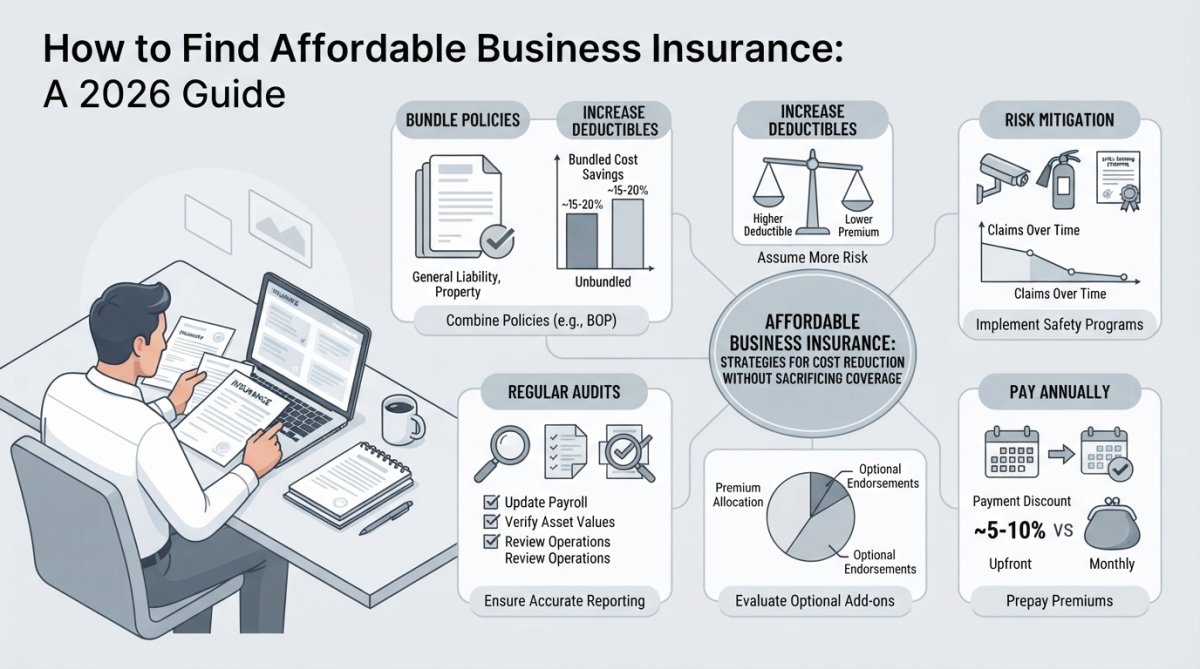
How to Reduce Business Insurance Costs Without Sacrificing Coverage
Step 1: Audit Your Current Policies for Overlap
If you’ve been with the same provider for years, you likely have overlapping coverage. You might be paying for general liability twice or have commercial property coverage in multiple policies.
Request declarations pages from every business insurance policy you carry. List coverage types and limits for each, then identify which coverages appear in multiple policies. For each overlap, determine which policy offers better terms and eliminate redundant coverage.
This audit typically reveals $500-$2,000 in annual savings for small businesses.
Step 2: Adjust Deductibles Strategically
Your deductible is the amount you pay before insurance kicks in. A higher deductible means a lower premium, but only if you can afford to pay it if a claim occurs.
A strategic approach uses different deductibles for different coverage types based on claim probability. General liability claims are relatively rare, so a higher deductible ($2,500-$5,000) makes sense. Workers’ compensation claims are more frequent, so a lower deductible ($500-$1,000) provides better protection.
Calculate premium savings for each deductible increase and compare it to your financial capacity. If moving from $1,000 to $2,500 saves $400 annually, that’s a 6-year payback period if you never file a claim.
Step 3: Bundle Policies for Multi-Policy Discounts
Insurance carriers offer substantial discounts when you bundle multiple policies. A Business Owner’s Policy bundled with workers’ compensation and commercial auto might earn a 10-15% discount across all policies.
Before bundling, compare the bundled quote to the sum of individual quotes from different carriers. Sometimes purchasing from multiple carriers is cheaper than bundling with one. Also ask about affinity discounts, industry association discounts, and safety-based discounts, which can provide 5-10% savings.
Step 4: Implement Risk Reduction Measures
Insurance carriers offer premium discounts for businesses that reduce their risk profile. Common discounts include safety training (5-10%), equipment maintenance (3-7%), loss prevention systems (5-15%), ergonomic assessments (3-5%), and drug-free workplace programs (2-5%).
Ask your carrier or broker what specific measures would qualify your business for discounts. Some require third-party verification but generate ongoing savings that pay back the investment within 1-2 years.
Eliminating overlap, optimizing deductibles, bundling strategically, and implementing one or two risk reduction measures typically reduces premiums by 15-25% without reducing actual protection.
Small Business Insurance Cost: Getting Quotes and Comparing
How to Request and Compare Free Quotes
Most carriers offer free online quotes in 15-30 minutes. Online quotes are preliminary estimates that carriers often adjust after underwriter review, but they provide a starting point for comparison.
Request quotes from at least three carriers using the same business description, coverage limits, and deductibles so you’re comparing equivalent coverage. Document each quote: carrier name, coverage types and limits, deductible amounts, total premium, and any discounts applied.
What Information You’ll Need to Provide
Gather this information before requesting quotes to ensure consistency across all carriers:
- Business legal structure
- Years in business
- Number of employees
- Annual revenue
- Specific business operations and services
- Business location(s) and square footage
- Claims history from the past 3-5 years
- Prior insurance coverage and limits
- Specialized equipment or vehicles used
- Employee payroll breakdown by classification
Evaluating Coverage Limits and Policy Terms
Once you have comparable quotes, evaluate whether the limits make sense for your business. Review policy terms carefully, some carriers exclude certain business activities or limit coverage in ways that matter to your operations.
Read the declarations page and coverage sections of the actual policy before committing. The quote shows what you’re buying, but the policy shows exactly what’s covered and excluded.
Insurance for Side Hustles and Freelancers: Affordable Options
Why Personal Insurance Isn’t Enough
Personal insurance policies explicitly exclude business-related liability and property damage. If you’re injured in a car accident while traveling to a client meeting, your personal auto insurance might deny the claim because you were using the vehicle for business. If a client is injured at your home office and sues, your homeowners insurance excludes the claim because it arose from business operations.
Cost-Effective Coverage for Independent Workers
A business owner’s policy designed for home-based businesses costs $300-$800 annually for freelancers and consultants. Professional liability insurance costs $400-$1,200 annually. Commercial auto insurance costs $100-$300 annually more than personal auto insurance.
Many freelancers combine a home-based business owner’s policy with professional liability insurance and commercial auto coverage for total annual costs under $2,000, providing comprehensive protection without traditional small business insurance premiums.
The Hidden Costs of Cheap Business Insurance
Inadequate Coverage Limits and Claims Denial Risks
The lowest-priced quote isn’t always the best value. A $300,000 general liability limit sounds adequate until a claim exceeds it. If a customer is seriously injured and damages total $800,000, your $300,000 limit covers only 37% of the claim, leaving you personally liable for $500,000.
Cheap insurance often means lower coverage limits, not just lower premiums for the same coverage. A $500 annual premium with $300,000 limits is not cheaper than a $600 premium with $1,000,000 limits if the higher limits are what your business needs.
Some carriers use aggressive underwriting practices to deny claims on technical grounds, such as missed reporting deadlines or minor application misstatements.
Long Claims Processing Times and Poor Support
When you file a claim, you need answers quickly. Cheap carriers often have minimal customer service infrastructure, resulting in days to weeks for claims processing. More established carriers with higher premiums typically have faster claims processing, dedicated adjusters, and better communication.
Regulatory Compliance Gaps in Low-Cost Plans
Some low-cost carriers operate on regulatory margins. They might offer coverage that technically meets state minimums but doesn’t actually protect you in practice.
Verify that any policy you consider complies with your state’s specific requirements and covers your actual business operations. Working with a broker or established carrier reduces this risk.
Choosing the lowest-priced quote without verifying coverage limits, exclusions, and claims handling reputation often results in inadequate protection or claim denials that cost far more than the premium savings.
Common Mistakes to Avoid When Finding Affordable Business Insurance
Underestimating Your Coverage Needs
Most business owners underestimate their liability exposure by focusing on catastrophic scenarios rather than mid-level claims that are statistically more likely to occur.
Audit your business operations with a focus on what could realistically go wrong. What injuries could employees sustain? What property damage could your work cause? What financial harm could result from your professional advice? This realistic assessment prevents underestimating coverage needs.
Ignoring Annual Policy Reviews
Your business changes year to year. You hire employees, add services, expand locations, or change operations. Your insurance should change with you.
Schedule an annual insurance review before your renewal date. Discuss business changes with your broker or carrier and adjust coverage limits and policy terms to match your current operations.
Failing to Disclose Important Business Details
Insurance applications ask detailed questions about your business operations. Failing to disclose important details or misrepresenting them creates grounds for claim denial later.
Answer all application questions accurately and completely. If a question is ambiguous, ask the carrier or broker for clarification before submitting your application.
Finding affordable business insurance requires understanding your actual risk profile, comparing coverage options strategically, and implementing cost-reduction tactics without sacrificing protection. The combination of eliminating overlap, optimizing deductibles, bundling policies, and implementing risk reduction measures typically saves 15-25% on premiums while improving your coverage.
At Colstan & Associates, we specialize in helping business owners navigate this process. Our team has over 20 years of experience identifying coverage gaps and negotiating better rates with carriers across 23+ states. We handle the complexity of comparing options, managing your renewal, and adjusting coverage as your business changes. Start with a free quote and discover how much you might be overpaying for your current coverage.
Frequently Asked Questions
What factors affect business insurance premiums?
Your premium depends on several key factors: your industry classification, annual revenue, business operations type, risk profile, number of employees, claims history, coverage limits you select, and deductible amounts. Insurance carriers also evaluate your location, whether you have safety protocols in place, and your underwriting profile. Working with a licensed agent helps identify which factors most impact your specific situation and where you can optimize costs without reducing necessary coverage.
How can I reduce my business insurance costs?
Start by auditing your policies for overlapping coverage, then strategically increase deductibles if you can handle higher out-of-pocket costs. Bundle multiple policies with one insurance carrier for multi-policy discounts. Implement risk reduction measures like safety training or security systems, these often qualify for premium discounts. Review your coverage annually to ensure you're not paying for protection you no longer need. Compare quotes from multiple carriers and ask about industry-specific discounts your business may qualify for.
Is it better to use an insurance broker or buy business insurance directly?
A licensed insurance broker provides personalized recommendations, compares quotes from multiple carriers, and handles policy management, valuable if your business has complex needs or you lack time to research options. Direct purchase from an insurance carrier works well for straightforward coverage needs and may feel faster. Brokers typically don't charge you directly; they earn commissions from carriers. For specialized coverage or businesses with unique risk profiles, a broker often saves money by finding the best-fit policy. For simple, low-risk businesses, direct purchase may be sufficient.
What's the difference between a Business Owner's Policy and general liability insurance?
A Business Owner's Policy (BOP) bundles general liability insurance with commercial property insurance, often at a lower combined cost than purchasing each separately. General liability insurance alone covers bodily injury and property damage claims from your business operations. A BOP adds protection for your physical assets like equipment, inventory, and the building itself. For small businesses, a BOP is typically more cost-effective and provides more comprehensive protection. Larger or specialized businesses may need to customize coverage beyond what a standard BOP offers.
This article was written using GrandRanker