


16 Sep How to Lower Home Insurance Rates After a Claim
Table of Contents
- Step 1: Understand How a Claim Affects Your Premium and Claims History
- How Long Do Insurance Claims Stay on Your Record?
- Home Insurance Deductible vs Premium: Where to Adjust First
- Ways to Lower Homeowners Insurance Without Switching Carriers
- Step 2: Reduce Risk With Home Security, Safety Upgrades, and Nuisance Removal
- Step 3: Time Your Shopping and Renewal Around Rate Stabilization
- Step 4: Review Coverage Limits, Rebuilding Costs, and State Regulations
- Common Mistakes That Keep Home Insurance Rates High After a Claim
- Frequently Asked Questions
Last Updated: September 13, 2026
Step 1: Understand How a Claim Affects Your Premium and Claims History
A single claim rarely triggers a permanent penalty, but it changes how an insurer prices your risk. The payout becomes part of your loss history, which feeds the risk score your carrier uses at renewal. This guide from Colstan & Associates walks through the steps that move your home insurance rates back down.
Most homeowners assume the increase is automatic and permanent. It isn’t. Insurers weigh severity, frequency, and how long you’ve been claims-free, so there is room to negotiate.
How Insurers Weigh Loss History and Risk After a Claim
Underwriting looks at more than the payout amount. Carriers assess the type of loss, whether it was preventable, and how it compares to similar homes nearby. A weather-related claim is treated differently from a plumbing failure a maintenance habit could have prevented.
That distinction shapes your strategy: if your claim was tied to a maintenance issue, insurers will expect corrective action before they reconsider your rate.
Ask your adjuster for the loss description that was filed. If it reads as “neglect” rather than “sudden and accidental,” that wording can follow you at renewal and is worth correcting early.
How Long Do Insurance Claims Stay on Your Record?
Most claims stay on your record for five to seven years, but the pricing impact fades sooner. Carriers weight the first two to three years most heavily, then step down the surcharge as your claims-free period rebuilds, a meaningful surcharge in year one, reduced in years two and three, and baseline pricing by year four or five for a single, non-repeat loss.
The timeline tells you when shopping pays off. Pulling quotes in month two produces the worst version of your risk profile; waiting until you have 18 to 24 claims-free months behind you produces quotes that reflect your recovery, not your loss.
Checking and Correcting Your CLUE Report
Your CLUE report, Comprehensive Loss Underwriting Exchange, maintained by LexisNexis Risk Solutions, is the claims database most insurers pull when they quote you. Errors are common: closed claims showing as open, duplicate entries, claims filed under a previous owner, or a loss reported but never paid.
A wrong entry can raise your premium even when you did nothing wrong, and it follows you from carrier to carrier because every insurer pulls from the same source. Correcting it is one of the highest-leverage moves after a claim.
How to dispute an entry:
- Request your free CLUE report from LexisNexis. You get one free report per year under the Fair Credit Reporting Act, plus another after an adverse action such as a rate increase or denial.
- Review every loss line by line. Confirm the date, cause of loss, amount paid, and whether the claim is open or closed.
- Dispute inaccuracies in writing. LexisNexis must investigate, generally within 30 days, and correct or delete anything it cannot verify.
- Keep the confirmation. A corrected report can change a quote before you call a new carrier, the correction is what makes the difference, not the dispute.
You can review the process through the Consumer Financial Protection Bureau guidance on disputing reports.
Order your CLUE report before you shop for new quotes, not after. If a carrier pulls a report with an error on it, the quote you receive reflects the error, and you will not know why the number came back high.
Waiting Periods and State Rules That Cap the Damage
Two forces determine how long a claim hurts your rate: your carrier’s surcharge schedule and your state insurance department’s rate-filing rules.
On the carrier side, ask your agent how long your insurer weights a new claim. Many apply the full surcharge for the first renewal, a reduced one for the second, and none by the third or fourth if no new losses occur. Some offer a first-claim waiver or claim forgiveness endorsement that eliminates the surcharge if you were claims-free for a set period.
On the state side, insurance departments in several states restrict how much a carrier can raise premiums after a single weather-related or catastrophe claim, and some prohibit surcharges for claims the homeowner could not have prevented. Rules on surcharges, cancellation windows, and rate filings differ by state, so the National Association of Insurance Commissioners state resources is the right place to confirm what applies where you live.
The two questions that shorten the tail of a claim: “How long does your surcharge schedule weight this loss?” and “Does my state cap post-claim increases for this type of loss?” Ask both before you decide whether to stay or shop.
Home Insurance Deductible vs Premium: Where to Adjust First
Raising your deductible lowers your premium because you absorb more of the risk. The trade-off is real: a higher deductible means more cash out of pocket, so you need enough in emergency savings to cover it.
| Adjustment | Effect on Premium | Best For | Trade-off |
|---|---|---|---|
| Raise deductible | Lowers premium | Homeowners with emergency savings | Higher out-of-pocket cost |
| Lower deductible | Raises premium | Those without a cash buffer | More predictable claim cost |
| Bundle policies | Lowers premium | Owners with auto and home | Ties renewals together |
Ways to Lower Homeowners Insurance Without Switching Carriers
Staying with your current carrier is often the fastest path to relief. Ask directly about discounts you may not be receiving: claims-free credits, loyalty adjustments, and safety equipment reductions.
Bundling Policies and Asking About Claim Forgiveness
Bundling home and auto with one carrier is one of the most reliable ways to lower homeowners insurance, and it’s worth asking about even if you’ve bundled for years. Claim forgiveness is the other lever: many carriers waive the first-claim surcharge if you’ve been claims-free for a set period, though eligibility varies by carrier and state.
The two questions worth asking your agent at every renewal: “Am I receiving every discount I qualify for?” and “Does my policy include first-claim forgiveness?”
Step 2: Reduce Risk With Home Security, Safety Upgrades, and Nuisance Removal
Risk mitigation is the part of this process homeowners control completely, and it is where the largest long-term savings live. Insurers reward homes that are harder to damage and break into, but only if the carrier knows about the improvements and believes they are permanent.
That last point is where most homeowners leave money on the table. A water shutoff valve or monitored alarm does nothing for your premium until it is documented, submitted, and reflected in your risk file. The steps below cover both the upgrades and the proof.
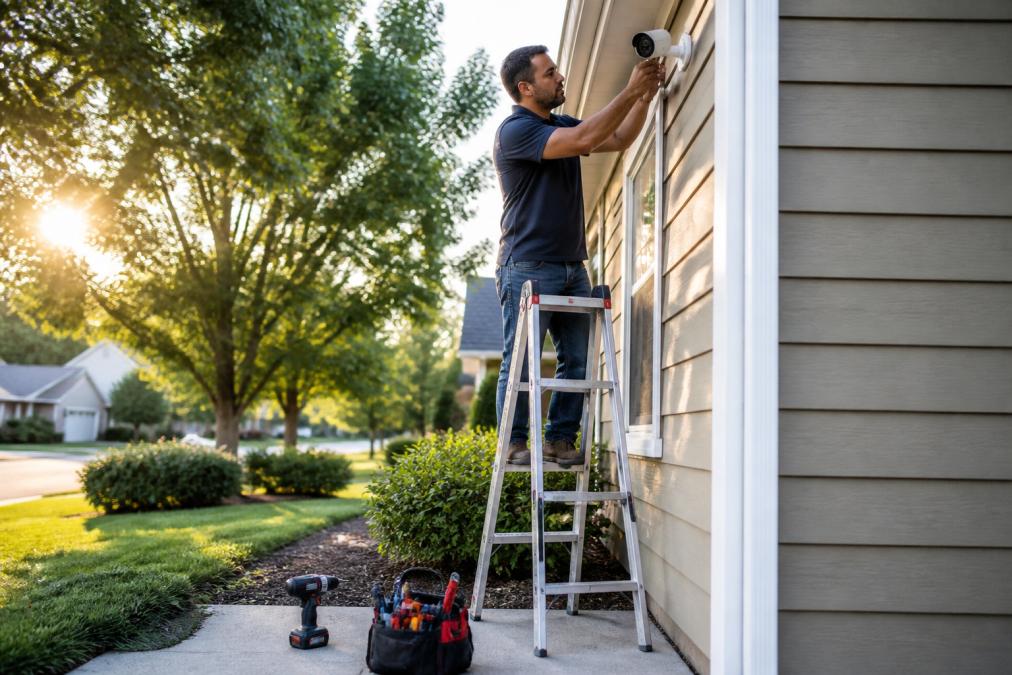
Match the Upgrade to the Loss You Filed
The most effective mitigation is the one aimed at the loss that actually happened. A carrier that just paid a water damage claim is far more interested in a leak detection system than in a new security camera. Proactive installation of such technology demonstrates a commitment to risk reduction that often simplifies the complexities involved in navigating water damage claims.
- After a water damage or plumbing claim: install a whole-home water shutoff valve with automatic leak detection, add individual leak sensors near the water heater, washing machine, dishwasher, and under every sink, and replace supply lines with braided stainless steel.
- After a theft or burglary claim: add a monitored security system with entry sensors, exterior cameras, motion-activated lighting, and reinforced door frames and deadbolts.
- After a fire claim: update smoke and carbon monoxide detectors, have the electrical panel inspected and any aluminum wiring or knob-and-tube remediated, and document chimney and dryer vent cleaning.
- After a wind or hail claim: replace worn roofing before it fails, install impact-rated shingles or a Class 4 roof where available, add storm shutters or impact glass, and trim trees away from the roofline.
- After a liability claim: remove attractive nuisances such as trampolines, unfenced pools, and neglected sheds, and document the removal with dated photos.
How to Prove Mitigation to an Underwriter
A discount is only as good as the evidence behind it. Underwriters discount unverifiable claims of improvement, so documentation matters as much as the work.
- Keep the receipt and the permit. A licensed contractor’s invoice, permit number, and manufacturer’s warranty are the strongest proof; a cash purchase with no paper trail is the weakest.
- Photograph the installation. Take dated photos of the finished work, model and serial numbers, and surrounding area, and store them in a folder you can send your agent.
- Get a written statement from the installer. A one-page letter on the contractor’s letterhead describing what was installed, when, and to what standard closes most underwriter questions.
- Send everything to your agent in writing. Ask them to submit it to underwriting and confirm in writing that the discount was applied, verbal assurances at renewal are easy to lose.
- Ask for the discount in writing at renewal. Request that the declaration page show the mitigation credit as a line item, and follow up before the renewal date if it does not appear.
Ask your agent which specific credits your carrier offers for the loss type you filed. Carriers publish their discount schedules internally, and an agent can tell you which upgrades actually move the premium versus which ones are cosmetic.
Removing Attractive Nuisances
A trampoline, unfenced pool, neglected shed, or dog with a bite history raises your liability exposure and shows up in your risk assessment. Removing the hazard is the fastest way to reduce that exposure, and documenting the removal lets the carrier reprice the risk.
If you cannot remove the hazard, a pool, for example, fencing, locking covers, and a signed safety acknowledgment can reduce the surcharge even when the feature stays. Ask your agent what the carrier requires before you spend money on the wrong fix.
Mitigation only lowers your rate when the carrier can verify it. Receipts, permits, dated photos, and a written confirmation from your agent that the credit was applied are what turn a home improvement into a premium reduction.
Step 3: Time Your Shopping and Renewal Around Rate Stabilization
Shopping for new quotes too soon after a claim usually produces disappointing numbers. Most carriers apply their surcharge immediately, so a quote taken weeks after a loss reflects the worst version of your risk profile.
Waiting periods vary by carrier and state, so ask your agent how long your current carrier weights a new claim. Many homeowners find a claims-free stretch of one to two years produces meaningfully better quotes than shopping the month after a payout. Time your renewal around that window, not your claim date.
Canceling your current policy before a new one is active creates a coverage gap. Lenders can force-place insurance at a much higher cost, which erases any savings you were chasing.
Step 4: Review Coverage Limits, Rebuilding Costs, and State Regulations
Coverage limits that no longer match rebuilding costs are a quiet source of overpayment. If your dwelling limit was set years ago and construction costs have risen since, you may be paying for a number that no longer reflects reality, or worse, one that leaves you underinsured.
Ask your agent to run a replacement cost estimate rather than relying on market value. Replacement cost covers what it takes to rebuild; actual cash value deducts depreciation. The gap between the two is significant after a loss.
State-specific insurance regulations also shape what carriers can charge and how they must handle your claim. Rules on surcharges, cancellation windows, and rate filings differ by state, so the National Association of Insurance Commissioners state resources is the right place to confirm what applies where you live. Colstan & Associates is licensed in more than 20 states, which means we can walk through the rules that govern your specific policy.
Common Mistakes That Keep Home Insurance Rates High After a Claim
Filing small claims is the mistake that costs homeowners the most over time. Paying for a minor repair yourself keeps your loss history clean, and a clean history is worth more than the payout. Set a claims threshold and stick to it.
Other mistakes that keep home insurance rates elevated:
- Letting a policy renew without reviewing the premium breakdown
- Skipping the CLUE report check and accepting an inaccurate entry
- Making upgrades without telling your carrier
- Dropping coverage to cut costs, then facing a large gap after a loss
- Shopping quotes in the weeks right after a claim instead of waiting
A common mistake is treating the renewal notice as a formality. That document is your best opportunity to question the surcharge, confirm your discounts, and decide whether to stay or shop.
A claim doesn’t have to define your premium for the next seven years, but recovering your rate takes deliberate action: correcting your loss history, documenting your risk upgrades, and timing your decisions around how carriers price risk. Colstan & Associates is a family-owned agency with more than 20 years of service in the insurance industry, and our licensed agents work with you on personalized policy reviews, bundling options, and coverage that matches your rebuilding costs rather than a generic estimate. Get started with Colstan & Associates and build a policy that protects what you’ve worked hard to build.
Frequently Asked Questions
Do home insurance rates go up after a claim?
In most cases, yes. Filing a claim signals higher risk to your insurance carrier, and your annual premium can rise at renewal. The size of the increase depends on your claims history, the type of loss, your deductible, and how your state regulates rate changes. A single weather-related claim often has less impact than a preventable incident like a water leak. Reviewing your policy renewal notice carefully helps you see exactly how the claim affected your premium.
How long does a home insurance claim stay on your record?
Most home insurance claims stay on your claims history for five to seven years, though this varies by insurance carrier and state regulations. A CLUE report, which insurers use to review your loss history, typically shows claims for up to seven years. During that window, your premium may stay elevated. After it drops off, your rate can improve, especially if you remain claims-free and maintain a good credit score.
Should I file a small home insurance claim?
Filing a small claim often costs more over time than paying out of pocket. A claim on your record can raise your premium for several years and may affect your claims-free discount. Run the numbers: if the repair cost is close to your deductible, an emergency savings fund may be the better route. Save claims for losses that genuinely exceed what you can absorb, and ask your agent how a specific claim would affect your rate before filing.
How can I improve my home insurance risk profile after a loss?
Start with a risk assessment of your property. Add safety equipment like a security system, smoke detectors, and water leak sensors. Remove attractive nuisances such as trampolines or unfenced pools. Maintain your home’s systems to prevent repeat losses, and ask your insurance carrier about claim forgiveness or a claims-free discount after a set period. A policy endorsement for replacement cost coverage can also protect you from future underinsurance.