


16 Sep Onedigital Alternatives: Personalized Service Comparison
Table of Contents
- Why Businesses Seek Onedigital Alternatives for Personalized Service
- Key Evaluation Criteria for Benefits Broker Evaluation Criteria
- Top Onedigital Alternatives: Side-by-Side Comparison
- 1. Colstan & Associates: Personalized Service as Standard Practice
- 2. Insperity: Enterprise-Grade Benefits with Dedicated Support
- 3. ADP TotalSource: Comprehensive PEO for Hands-Off HR
- 4. TriNet: Flexible HR Solutions with Built-In Scheduling
- 5. Gusto: Affordable, Transparent Pricing for Growing Teams
- How Employee Benefits Consulting Firms Deliver Personalized Service
- Addressing Common Pain Points: What Matters Most to Plan Sponsors
- Making the Switch: Implementation and Migration Considerations
- Frequently Asked Questions
Last Updated: August 9, 2026
According to research from the Society for Human Resource Management, businesses that switch to specialized benefits providers report significantly improved employee satisfaction and reduced administrative overhead. Yet finding the right alternative to Onedigital for personalized service remains challenging for plan sponsors who’ve outgrown their current provider or need more tailored support.
At Colstan & Associates, we understand that one-size-fits-all benefits solutions don’t work for companies with unique needs. This guide compares Onedigital alternatives for personalized service across the criteria that matter most: dedicated account management, customization flexibility, technology integration, and genuine advisory support. Whether you’re managing a growing team or operating a specialized business, you’ll find concrete options to evaluate.
Why Businesses Seek Onedigital Alternatives for Personalized Service
Companies typically outgrow their current benefits provider when the platform becomes impersonal as they scale, technology feels dated, or the advisory team treats them as a transaction rather than a partnership. Plan sponsors increasingly expect their benefits consultant to act as a strategic partner who understands their industry, proactively identifies cost-saving opportunities, and manages renewals without constant follow-up.
A common mistake is assuming that switching providers means starting from scratch. Modern benefits brokers have simplified migration processes. The real cost is evaluating which alternative actually delivers personalized service, differences emerge in execution: response times, renewal management, claims support, and willingness to customize solutions.
The right alternative combines transparent pricing, accessible advisory support, and technology that integrates with your existing HR systems. Personalized service means proactive management and genuine customization, not just a dedicated contact.
Key Evaluation Criteria for Benefits Broker Evaluation Criteria
When comparing Onedigital alternatives for personalized service, focus on specific operational factors rather than marketing claims.
Dedicated Account Management Structure. Determine whether you’ll have a single point of contact or a team. Ask how many clients each broker manages per representative, a broker managing 50 accounts can provide more attention than one managing 200. Request the specific name and contact information of your assigned broker before committing.
Renewal Process and Timeline. Ask how the broker handles renewals: Do they conduct a full market analysis annually? Do they present multiple options with side-by-side comparisons? Do they proactively identify cost-saving opportunities? A responsive broker should contact you 90 days before renewal, not 30 days.
Technology Integration and Reporting. Verify that the broker’s platform integrates with your payroll system and HRIS. Can employees access benefits information through a single portal? Does the broker provide custom reporting on plan use, costs, and trends?
Claims and Member Support Responsiveness. Ask about average response times for employee questions and claims issues. Brokers that manage claims escalation internally typically respond within 24 hours. Request references from current clients and specifically ask about claims experience.
Customization Flexibility. Confirm whether the broker can mix and match carriers to build a plan that fits your budget and employee needs, rather than forcing you into pre-packaged solutions.
Industry-Specific Expertise. If you operate in a specialized field, ask whether the broker has experience with similar businesses and understands your industry’s typical claims patterns, regulatory requirements, and employee demographics.
| Evaluation Factor | What to Ask | Red Flag |
|---|---|---|
| Account Management | How many clients per broker? Who is my dedicated contact? | Generic answer or “someone from the team will handle it” |
| Renewal Process | When do you start the renewal analysis? How many options do you present? | Less than 60 days notice or single-option presentations |
| Technology | Does your platform integrate with our payroll system? | Manual data entry required or separate logins for employees |
| Claims Support | Average response time for member questions? | Unclear answer or “depends on the carrier” |
| Customization | Can you mix carriers to build a custom plan? | Limited to pre-packaged options only |
| Industry Knowledge | Do you work with businesses like ours? | Generic response or no relevant references |
Top Onedigital Alternatives: Side-by-Side Comparison
1. Colstan & Associates: Personalized Service as Standard Practice
Colstan & Associates stands apart as a family-owned insurance agency with genuine commitment to personalized service. Licensed agents in 23+ states provide direct access to experienced advisors who understand your specific situation. The team manages renewals proactively, identifies cost-saving opportunities, and responds to employee questions with genuine expertise.
For businesses with specialized needs, Colstan & Associates demonstrates proven capability. Their partnership with Hagerty Insurance for classic car coverage shows their willingness to source specialized solutions rather than force generic products. This same approach applies to benefits consulting: they build customized plans rather than offering cookie-cutter packages. Colstan & Associates minimizes friction in the claims process and maintains consistent client retention over two decades, recognized as Merchants Insurance Group’s Agent of the Year in 2024.
Businesses of any size seeking genuine personalized service, companies with specialized insurance needs, and plan sponsors who value direct access to experienced advisors rather than being passed between departments.
2. Insperity: Enterprise-Grade Benefits with Dedicated Support
Insperity appeals to businesses ready to outsource their entire HR function. As a Professional Employer Organization (PEO), Insperity becomes a co-employer, handling payroll, tax compliance, and HR operations alongside benefits administration.
The core strength is access to enterprise-level benefits at competitive rates through pooled employee negotiations. Dedicated HR specialists provide strategic guidance on compensation, compliance, and talent management. The trade-off is scope: Insperity’s strength in comprehensive HR outsourcing becomes a limitation if you only need benefits consulting. Pricing starts around $150 per employee per month.
Growing companies ready to fully outsource HR operations, businesses without dedicated HR staff, and organizations that value integrated payroll, benefits, and compliance management under one provider.
3. ADP TotalSource: Comprehensive PEO for Hands-Off HR
ADP TotalSource operates similarly to Insperity as a full-service PEO. ADP’s strength is platform integration, if your business already uses ADP for payroll or accounting, TotalSource integrates seamlessly. Workers’ compensation administration is a notable strength, with claims management and return-to-work coordination included.
The primary limitation is transparency. Pricing isn’t publicly disclosed, and custom quotes often exceed comparable PEO options. You’re also locked into ADP’s ecosystem; switching becomes difficult if you want to maintain integration with existing systems.
Mid-sized businesses already invested in ADP systems, companies needing comprehensive workers’ compensation management, and organizations that prioritize platform integration over shopping for individual carriers.
4. TriNet: Flexible HR Solutions with Built-In Scheduling
TriNet offers flexibility that larger PEOs don’t: you can choose between full PEO services or their HR Plus model (ASO, Administrative Services Only). The scheduling and attendance tools are genuinely useful, with time tracking built into the core platform. Access to HR experts for guidance on compliance, onboarding, and employee relations is available regardless of service level.
The limitation is the five-employee minimum for PEO services. Pricing isn’t transparent online, requiring custom quotes that complicate comparison.
Small to mid-sized businesses with hourly employees, companies that want flexibility between PEO and ASO models, and organizations that prioritize integrated scheduling and attendance management.
5. Gusto: Affordable, Transparent Pricing for Growing Teams
Gusto provides a software platform with integrated payroll, benefits administration, and basic HR tools. You maintain control of your HR operations while using their technology to simplify execution. Pricing is transparent: $49 per month plus $6 per employee per month with no hidden fees.
The limitation is scope. Gusto works well for straightforward benefits needs but struggles with complex customization. If you need to mix multiple carriers or design unusual plan structures, options are limited. At scale, the per-employee fee model becomes expensive compared to PEO models that negotiate volume discounts.
Startups and small businesses under 50 employees, companies that prioritize transparent pricing and ease of use, and organizations that don’t need complex benefits customization or dedicated advisory support.
How Employee Benefits Consulting Firms Deliver Personalized Service
The distinction between generic benefits administration and genuine personalized service comes down to operational structure and incentives. True personalization requires advisors who understand your business deeply enough to make recommendations that fit your specific situation.

Proactive Renewal Management. Personalized brokers initiate the renewal process 90+ days before expiration, conducting a full market analysis and identifying which benefits employees actually use and where you’re overpaying.
Customized Plan Design. Rather than forcing clients into pre-packaged tiers, personalized brokers build plans from components, for example, recommending a lower deductible for preventive care while increasing deductibles for specialty services to reduce employee out-of-pocket costs for common needs while controlling your premium.
Industry-Specific Guidance. A broker who understands your industry recognizes typical claims patterns and employee demographics. An auto repair shop has different risk profiles than a tech startup, informing better plan recommendations.
Responsive Claims Advocacy. When employees file claims, personalized service means the broker actively manages the process, following up with carriers and escalating problems before they become frustrations.
Transparent Communication. Personalized brokers explain trade-offs clearly and don’t hide fees in carrier commissions.
Addressing Common Pain Points: What Matters Most to Plan Sponsors
Plan sponsors consistently report the same frustrations with benefits brokers.
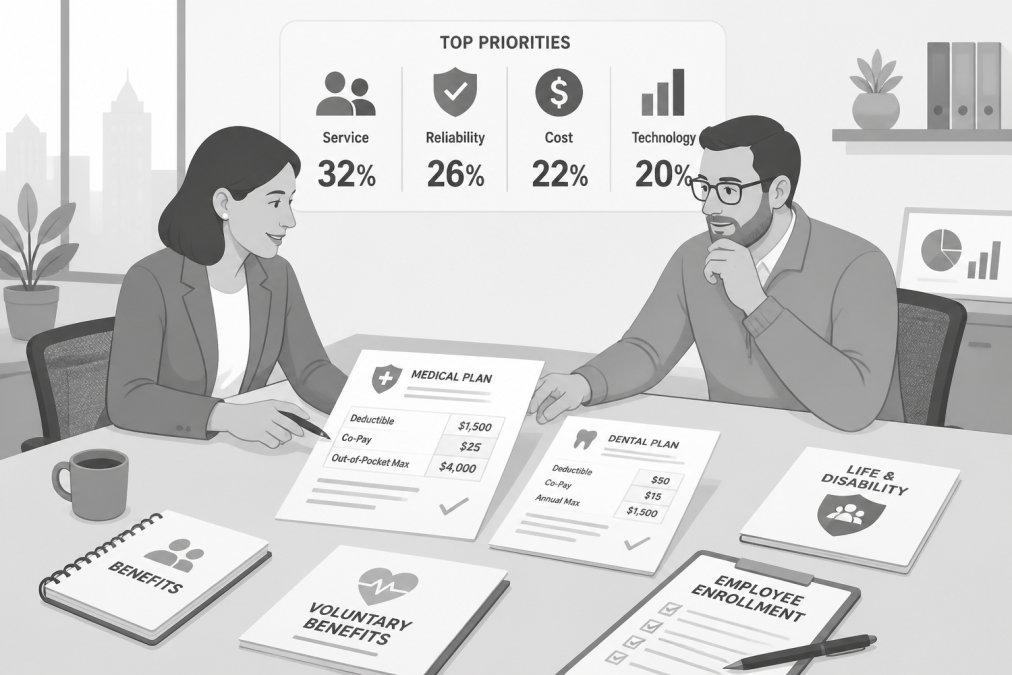
Slow Response Times. Employees file claims or have questions, and no one responds for days. Personalized brokers manage escalation internally, ensuring responses within 24 hours.
Renewal Surprises. Renewals arrive with unexpected 15-20% hikes because brokers don’t actively manage the renewal process. Personalized brokers present multiple options with detailed analysis of rate changes.
Lack of Proactive Guidance. Your broker disappears after the sale, then reappears at renewal time. Personalized brokers conduct regular check-ins and recommend adjustments before problems arise.
Limited Customization. You’re forced into standard plan designs that don’t fit your business. Personalized brokers build custom solutions.
Unclear Costs. You don’t know what you’re actually paying for benefits administration. Transparent brokers disclose all costs upfront.
Industry Misunderstanding. Your broker treats your auto repair shop the same as a law firm, missing specific risks and needs. Personalized brokers develop expertise in your sector.
These pain points explain why plan sponsors seek alternatives. They’re not looking for cheaper; they’re looking for better, responsive, proactive, transparent, and genuinely customized.
Making the Switch: Implementation and Migration Considerations
Switching benefits brokers concerns most plan sponsors because they assume it’s operationally complex. In reality, modern brokers have simplified the process.
Timeline and Coordination. Plan changes typically occur on the first day of your plan year. Begin evaluation 120 days before your renewal date to allow time for decision-making and broker preparation.
Data Migration and Accuracy. Your new broker needs accurate employee census data: names, dates of birth, salary information, and dependent coverage elections. Review this carefully before submitting to carriers.
Communication with Employees. Employees need to understand that their coverage continues without interruption. New ID cards arrive before the plan effective date.
Carrier Elections and Underwriting. Some carriers require new applications when you switch brokers. This is routine and doesn’t affect coverage, typically taking 2-3 weeks for approvals.
System Integration. Ensure your new broker’s platform integrates with your payroll system and HRIS. Test the integration before the effective date.
Continuity of Coverage. There’s no gap in coverage when you switch brokers. The old plan ends on the last day of your plan year; the new plan begins the next day.
The biggest mistake is switching brokers mid-year. Plan your transition for your renewal date.
Switching to a benefits provider that delivers genuine personalized service doesn’t have to be complicated. The right alternative combines responsive support, industry expertise, and transparent communication, qualities that distinguish providers like Colstan & Associates from impersonal national platforms. If your current broker treats you as a transaction rather than a partnership, or if you’re frustrated by slow response times and lack of proactive guidance, it’s time to evaluate alternatives that actually deliver on the promise of personalized service. Colstan & Associates brings over 20 years of experience and a proven track record as Merchants Insurance Group’s 2024 Agent of the Year, applying the same client-focused philosophy that defines their personal and commercial insurance work to comprehensive benefits consulting. Start a conversation with Colstan & Associates today to discover how personalized advisory service can improve your employee benefits strategy and protect your business.
Frequently Asked Questions
What makes Onedigital alternatives stand out for personalized service?
Onedigital alternatives differentiate through dedicated account management, proactive renewal outreach, and customized benefit packages tailored to specific business needs. Unlike generic brokers, firms like Insperity and TriNet assign HR specialists who understand your industry and workforce composition. They conduct regular compliance reviews, offer strategic guidance on plan design, and maintain ongoing communication rather than transactional interactions. Personalized service means your broker knows your business goals, employee demographics, and cost pressures, and adjusts recommendations accordingly.
How should I evaluate employee benefits consulting firms when comparing options?
Start with industry experience: does the firm work with businesses your size and in your sector? Check their response time for claims and renewals, aim for 24-48 hour turnarounds. Assess transparency: can they clearly explain fee structures and show you actual rate quotes before commitment? Verify their advisory approach: do they conduct annual benefits audits, offer employee communication support, and help with plan education? Ask for references from current clients with similar employee counts. Finally, confirm they hold proper licensing and maintain compliance expertise for your state.
What’s the typical cost difference between Onedigital and its alternatives?
Pricing varies significantly by model. Gusto starts at $49 per month plus $6 per employee, making it budget-friendly for small teams. Insperity averages $150 per employee per month for full-service PEO. ADP TotalSource and TriNet require custom quotes, typically ranging higher for mid-market businesses. Boutique insurance brokers like Colstan & Associates offer flexible arrangements based on your coverage complexity and service level. Rather than assuming cost, request quotes from 2-3 options using identical employee counts and benefit scenarios to compare apples-to-apples.
How long does it take to migrate from Onedigital to an alternative provider?
Migration typically takes 4-8 weeks depending on your plan complexity and carrier coordination. The new broker needs time to gather your current plan documents, employee census data, and renewal information from your existing carrier. They’ll then coordinate with carriers for benefit plan transfers, payroll system integration, and employee communication. Most brokers handle the heavy lifting, you mainly provide documentation and approve timeline. Plan the transition during your renewal window to minimize disruption. Expect 2-3 weeks of overlap where both brokers coordinate to ensure no coverage gaps.
This article was written using GrandRanker