


16 Sep Personalized Home Insurance Coverage Review: A 2026 Guide
Table of Contents
- Why a Personalized Home Insurance Coverage Review Matters
- Homeowners Insurance Coverage Checklist: What You Need to Audit
- How to Calculate Home Replacement Cost Accurately
- Home Insurance Policy Review Questions to Ask Your Agent
- Identifying Coverage Gaps and Policy Endorsements
- Lowering Your Premiums Without Sacrificing Protection
- Understanding the Claims Process and Customer Satisfaction
- Frequently Asked Questions
Last Updated: August 5, 2026
Why a Personalized Home Insurance Coverage Review Matters
Most homeowners buy a policy and forget about it for years, assuming coverage stays adequate as their life changes and possessions accumulate. Then a claim happens, and they discover gaps they never knew existed.
A personalized home insurance coverage review aligns what you’re actually protected for with what you actually own and what you’re actually exposed to. Colstan & Associates has spent over 20 years helping families and business owners uncover these mismatches: most people are either underinsured on the things that matter most or overinsured on things they don’t need.
The stakes are real. Underinsurance on dwelling coverage means you can’t fully rebuild after a loss. Underinsurance on liability means a lawsuit could wipe out your assets. Missing endorsements for high-value items means your jewelry, art, or collectibles aren’t protected at all. On the flip side, paying for coverage you don’t need wastes hundreds of dollars annually.
This guide walks you through a structured approach to reviewing your homeowners insurance. You’ll learn what to audit, what questions to ask your agent, how to spot gaps, and how to lower your premiums without sacrificing protection.
Homeowners Insurance Coverage Checklist: What You Need to Audit
The foundation of a good coverage review is knowing what to look for. Most people don’t understand the difference between dwelling coverage and personal property coverage, or why replacement cost matters more than actual cash value.
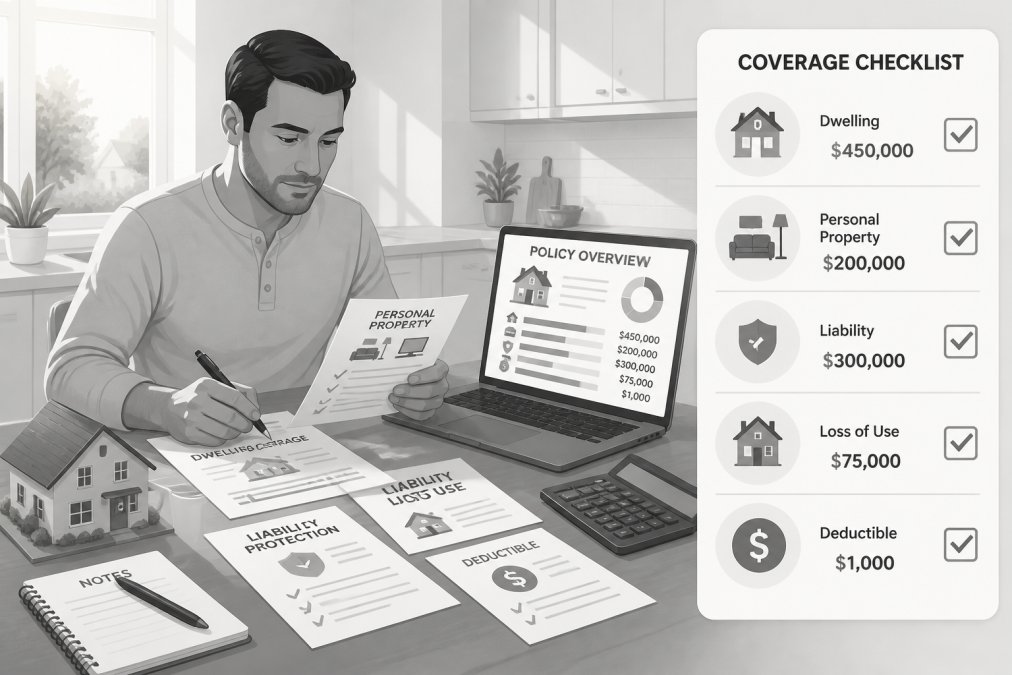
Dwelling Coverage and Replacement Cost Protection
Dwelling coverage protects the structure of your home, walls, roof, foundation, built-in appliances, and permanent fixtures. The critical distinction is between replacement cost and actual cash value.
Replacement cost coverage pays what it costs to rebuild your home today using current materials and labor rates. Actual cash value pays the replacement cost minus depreciation. If your roof is 10 years old and a storm damages it, replacement cost covers a new roof; actual cash value covers a new roof minus depreciation.
Rebuilding a 2,000-square-foot home costs $300,000 to $500,000 or more depending on location and construction standards. If your dwelling limit is set too low, you face a coverage gap. After a total loss, you’re responsible for the difference.
Calculate your home’s replacement cost by considering square footage, local construction costs, and materials used. Colstan & Associates recommends reviewing this calculation every 2-3 years, especially after significant renovations or if construction costs in your area have risen. Inflation guard endorsements can help your limits keep pace automatically.
Personal Property and High-Value Item Coverage
Personal property coverage protects your belongings, furniture, electronics, clothing, appliances. Standard policies typically cover personal property at 50-70% of your dwelling coverage limit. For most households, this is adequate.
However, high-value items have special limitations. Jewelry, collectibles, art, and antiques are often capped at $1,500 to $2,500 total, regardless of actual value. If you own a valuable watch collection, engagement ring, or art collection worth $50,000, that cap is meaningless.
Scheduled personal property endorsements solve this. You list specific high-value items, provide documentation (appraisals, receipts, photos), and add them to your policy. They’re covered at full value without standard sublimits. The cost is modest, typically $50 to $200 per year per item.
Liability Protection and Medical Payments Coverage
Liability coverage protects you if someone is injured on your property or if you accidentally damage someone else’s property. Standard limits are typically $100,000 to $300,000. Medical payments coverage covers immediate medical expenses for guest injuries, even if you’re not legally liable, with limits typically $1,000 to $5,000.
For high net worth individuals or those with significant assets, standard liability limits are often insufficient. A serious injury lawsuit could exceed $300,000 easily. Umbrella liability coverage provides an additional $1 million to $5 million in protection, sitting above your homeowners and auto policies. The cost is surprisingly affordable, often $150 to $300 per year for $1 million in additional coverage.
How to Calculate Home Replacement Cost Accurately
Underestimating replacement cost is one of the most common mistakes homeowners make. You can’t rely on your home’s market value or purchase price. Replacement cost depends on construction type, square footage, local labor rates, and material costs.
Start by getting your home’s square footage from your property tax assessment or recent appraisal. Then research local construction costs. The National Association of Home Builders publishes regional cost data. Insurance companies also use cost estimating tools that factor in your specific location, construction type, and home characteristics.
Contact a local contractor and ask for an estimate to rebuild your home from the ground up, including all permanent fixtures, kitchen cabinets, flooring, and built-in appliances. Don’t include landscaping or site preparation; those are typically excluded from dwelling coverage.
Once you have a replacement cost figure, add 10-15% as a buffer for cost inflation. That’s your target dwelling coverage limit. If your current limit is significantly lower, you have a coverage gap. If it’s significantly higher, you’re likely overpaying.
Home Insurance Policy Review Questions to Ask Your Agent
A good insurance agent is a partner in your coverage strategy. When you sit down to review your policy, come prepared with specific questions. This conversation should happen every 2-3 years, or whenever your life circumstances change, you buy a rental property, your home appreciates significantly, you acquire high-value items, or you retire.

Ask your agent to walk you through your coverage limits: dwelling, personal property, liability, and medical payments. Ask whether these align with your actual replacement cost and asset protection needs. Ask what your policy excludes, flood, earthquake, and certain types of water damage are typically excluded.
Get specific about your situation. If you have high-value items, ask about scheduled personal property endorsements and required documentation. If you own a rental property, ask whether your homeowners policy covers it (it typically doesn’t; you need a landlord policy). If you work from home, ask whether business equipment is covered. If you have a pool or trampoline, ask what coverage applies.
Ask about premium reduction opportunities. Many insurers offer discounts for bundling home and auto policies, installing security systems, maintaining good credit, or completing a home safety inspection. Ask what discounts you qualify for.
Finally, ask about the claims process. How do you report a claim? What’s the typical response time? Does the insurer have local adjusters? How are disputes resolved? Understanding the process in advance removes confusion during a stressful time.
Identifying Coverage Gaps and Policy Endorsements
After reviewing your current coverage, identify gaps, spaces between what your policy covers and what you actually need protection for.
Common gaps include:
Flood damage. Standard homeowners policies exclude flood damage. If you live in a flood-prone area, you need a separate flood insurance policy through the National Flood Insurance Program (NFIP) or private insurers.
Water damage from certain sources. Homeowners policies cover sudden, accidental water damage (a burst pipe) but not gradual leaks, seepage, or water damage from lack of maintenance.
Earthquake damage. Standard policies exclude earthquake damage. In seismic zones, earthquake endorsements are essential.
Business property. If you run a business from home, your business equipment and inventory typically aren’t covered. You need a home-based business rider or commercial general liability policy.
High-value collections. Standard policies cap coverage on jewelry, art, and collectibles. Scheduled personal property endorsements close this gap.
Loss of use. If your home becomes uninhabitable after a covered loss, your policy covers temporary housing, but limits might be insufficient in expensive areas.
Solutions include endorsements, additions to your base policy that extend coverage or increase limits. Common endorsements include scheduled personal property, inflation guard, replacement cost endorsement for personal property, loss of use extension, water backup coverage, and earthquake endorsement. Each adds a small amount to your premium; the question is whether the protection justifies the cost.
| Coverage Gap | Typical Cause | Recommended Solution | Estimated Cost |
|---|---|---|---|
| Flood damage | Standard exclusion | NFIP or private flood policy | $300-$1,200/year |
| Water damage (gradual) | Maintenance exclusion | Water backup endorsement | $50-$150/year |
| Earthquake damage | Standard exclusion | Earthquake endorsement | $100-$500/year |
| High-value items | Sublimit caps | Scheduled personal property | $50-$300/year per item |
| Loss of use | Insufficient limit | Loss of use extension | $25-$100/year |
| Business property | Homeowners exclusion | Home business rider | $200-$500/year |
Lowering Your Premiums Without Sacrificing Protection
Insurance premiums feel fixed, but they’re not. There are legitimate ways to reduce your premium without cutting coverage or increasing your deductible.
Start with discounts. Ask your agent about every discount your insurer offers: bundling (home + auto), good driver discount, good student discount, claims-free discount, safety features (alarm system, deadbolts, sprinkler system), and home improvements (new roof, updated electrical system). Some insurers offer usage-based discounts if you install a monitored home security system.
Review your deductible. A higher deductible lowers your premium. Increasing from $500 to $1,000 might drop your premium 10-15%. This makes sense if you have emergency savings to cover the higher out-of-pocket expense.
Challenge your rate. Insurance companies adjust rates annually. Your rate might have gone up even though your risk hasn’t changed. Get quotes from other insurers. If competitors offer lower rates for the same coverage, your current insurer might match their offer.
Look for structural changes that lower risk. A new roof, updated electrical system, or new plumbing can qualify you for discounts. Installing a security system might also help.
One caution: don’t sacrifice coverage to save money. Dropping your liability limit from $300,000 to $100,000 to save $30 per year is a bad trade. The goal is to optimize coverage and cost, not minimize cost at the expense of protection.
Understanding the Claims Process and Customer Satisfaction
Your homeowners insurance is only valuable if it works when you need it. Understanding the claims process and the insurer’s reputation for claims handling should influence your policy choice.
When a covered loss occurs, you report it to your insurer. The insurer assigns an adjuster, who inspects the damage, reviews your coverage, and determines what’s covered and how much to pay. For minor claims, this might take a few days. For major losses, it can take weeks or months.
The quality of this experience varies dramatically between insurers. Some have local adjusters who respond quickly and handle claims fairly. Others use national networks of adjusters who might be unfamiliar with local building codes.
Customer satisfaction ratings provide insight. The National Association of Insurance Commissioners (NAIC) tracks complaint ratios by insurer. J.D. Power publishes annual claims satisfaction ratings. These resources show which insurers customers trust to handle claims fairly and quickly.
Ask your agent about their insurer’s claims process. How many local adjusters do they have? What’s the average time to first contact? How are disputes resolved? Can you file claims online or through a mobile app?
A personalized home insurance coverage review isn’t something you do once and forget. It’s an ongoing process that evolves as your life changes, your home appreciates, and your risk profile shifts.
Start with an honest assessment of what you own and what you’re exposed to. Calculate your true replacement cost. Review your current coverage against that reality. Identify gaps and fill them with endorsements. Optimize your premiums through discounts and rate shopping. Choose an insurer with a reputation for fair claims handling.
Colstan & Associates can guide you through this entire process. With over 20 years of experience and licensed agents across 23+ states, we’ve helped thousands of families and business owners build coverage that actually protects what matters. We treat every client like part of the Colstan family, which means we listen to your specific situation, ask the right questions, and recommend coverage that fits your needs and budget. Start a quote with us and let’s make sure your home is truly protected.
Frequently Asked Questions
How often should I review my homeowners insurance coverage?
Review your personalized home insurance coverage annually or whenever major life changes occur, such as home renovations, purchasing high-value items, or significant increases in home value. After major events like storms or claims, reassess your coverage limits. Many homeowners find that annual reviews during policy renewal time work best, allowing you to adjust coverage and explore premium reduction opportunities before your policy renews.
What does a personalized home insurance policy include?
A personalized home insurance policy includes dwelling coverage for your home’s structure, personal property coverage for your belongings, liability protection against injury claims on your property, and medical payments coverage. Depending on your needs, it may also include loss of use coverage, inflation guard endorsements, and specialized coverage for high-value items like jewelry or classic vehicles. Your specific coverage depends on your home’s value, location, and individual risk factors.
How do I know if I have enough dwelling coverage for my home?
Calculate your home’s replacement cost by determining the cost to rebuild your home from the ground up, excluding land value. This includes materials, labor, and building codes. Compare this figure to your current dwelling coverage limit. Many homeowners underestimate replacement costs; if your coverage falls short of the actual replacement cost, you risk significant out-of-pocket expenses after a loss. Professional home appraisals or replacement cost calculators can help ensure your coverage is adequate.
Does my home insurance cover high-value items like jewelry?
Standard homeowners insurance policies typically limit personal property coverage for high-value items like jewelry, artwork, and collectibles. Most policies cap jewelry coverage at $1,500 to $2,500 total. For items exceeding these limits, you can purchase policy endorsements or scheduled personal property coverage that specifically lists and covers these valuables at their full replacement cost. This specialized coverage is especially important for high net worth individuals with significant assets to protect.
This article was written using GrandRanker